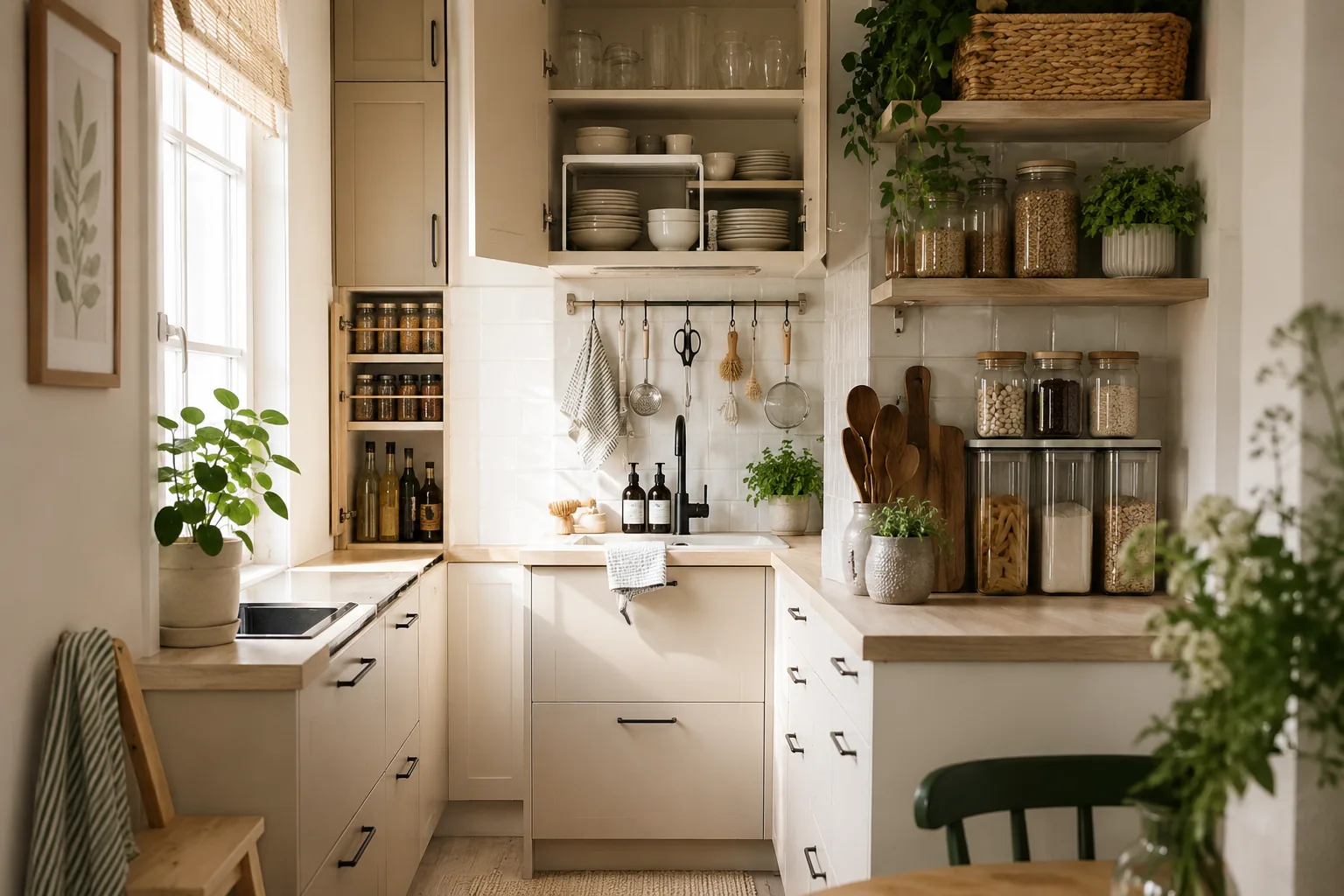
Storage products save space only when they solve the right problem. A pull-out organizer may improve a deep lower cabinet, while a shelf riser may be the better answer for a short stack of dishes. Buying the wrong type can reduce clearance, block plumbing, or create another surface that is difficult to reset.
Use this guide to compare ten common storage formats before choosing a product. If you are still deciding what part of the room needs attention, begin with our small-kitchen organization guide or explore the Small Kitchen room page.
At a glance
Quick Comparison: Which Storage Solution Fits Your Problem?
Use this overview to narrow the list, then open the full guidance for the options that suit your space.
| Storage solution | Best for | Measure first | Installation |
|---|---|---|---|
| Under-sink organizers | Deep cabinets where bottles disappear behind plumbing | Clear width, depth, height, and pipe clearance | None or light assembly |
| Pull-out cabinet organizers | Deep base cabinets that are difficult to reach | Narrowest door opening plus full pull-out travel | Usually fixed inside cabinet |
| Shelf risers | Short dishes or pantry items under tall shelves | Items must fit both below and above the riser | Usually none |
| Vertical pan and lid organizers | Pans, lids, trays, and boards in tall cabinets | Largest item, handles, slots, and door clearance | None, or secure to cabinet |
| Drawer organizers | Small utensils that overlap or migrate in drawers | Internal drawer width, depth, and usable height | Usually none |
| Lazy Susans and turntables | Similar bottles or jars on deep shelves and corners | Largest clear circle and height while rotating | Usually none |
| Slim rolling storage carts | A real unused gap with a clear pull-out path | Narrowest gap, baseboards, wheels, and walkway | Light assembly |
| Over-door storage | Light items on a pantry or sturdy cabinet door | Door thickness, top gap, swing, and rear clearance | Hang or lightly secure |
| Countertop organization | A few genuinely daily items used in one routine | Footprint, upper-cabinet height, lids, cords, and outlets | None |
| Wall and vertical storage | Lightweight daily tools near their point of use | Wall area, reach, projection, fixings, wiring, and heat | Wall fixing usually required |
Make this guide manageable
Turn this guide
into a plan.
Choose one problem and the time you have today. We’ll create a short, practical plan and remember your progress on this device.
Under-sink organizers

- Best for
- Deep cabinets where bottles disappear behind plumbing
- Space needed
- Clear width, depth, height, and pipe clearance
- Avoid when
- Valves are blocked or children can reach unsafe cleaners
Read the full decision guide
- The problem it solves
- They turn the awkward space around pipes into reachable zones for cleaning supplies, cloths, dishwasher items, or bin liners. A removable caddy can also make the cabinet easier to empty when plumbing needs attention.
- Best for
- Deep sink cabinets where small bottles disappear at the back and the plumbing leaves usable space on one or both sides.
- Measure before choosing
- Measure the clear interior width, depth, and height with the doors shut. Mark the exact position of pipes, valves, disposal equipment, hinges, and any point that must remain reachable.
- What to look for
- Adjustable shelves that fit around plumbing, water-resistant surfaces, removable trays, stable feet, and pull-outs with stops. A layout that can be lifted out quickly is more useful than a tightly fitted maze.
- When to skip it
- Avoid fixed systems that block shutoff valves or hide signs of a leak. This may also be the wrong location for hazardous cleaners when children or pets can access the cabinet.
Pull-out cabinet organizers

- Best for
- Deep base cabinets that are difficult to reach
- Space needed
- Narrowest door opening plus full pull-out travel
- Avoid when
- Plumbing, hinges, or rental rules prevent installation
Read the full decision guide
- The problem it solves
- A pull-out brings the back of a deep lower cabinet toward you, reducing kneeling, reaching, and the need to remove front items before finding something behind them.
- Best for
- Deep base cabinets holding pots, pantry staples, food containers, or small appliances that are difficult to reach from the front.
- Measure before choosing
- Measure the narrowest clear opening—not just the cabinet box—including the face frame, hinges, and door hardware. Record usable depth and height, then check the full travel path when nearby doors and drawers are open.
- What to look for
- Full-extension runners, a suitable load rating, secure stops, removable baskets, adjustable dividers, and hardware designed for the cabinet construction. Smooth movement matters more than maximum capacity.
- When to skip it
- Skip drilling-based models in rentals unless permitted. They are also a poor fit where plumbing, wide hinges, uneven cabinet floors, or a narrow face frame prevents a straight installation.
Shelf risers

- Best for
- Short dishes or pantry items under tall shelves
- Space needed
- Items must fit both below and above the riser
- Avoid when
- The shelf mostly holds tall bottles or appliances
Read the full decision guide
- The problem it solves
- A riser uses the air above short dishes, cups, jars, or pantry packages so two groups can share one shelf without becoming one unstable stack.
- Best for
- Cabinets with generous vertical spacing and several short categories that are currently stacked on top of one another.
- Measure before choosing
- Measure shelf width and depth, the vertical distance to the shelf above, and the height of the tallest item that must fit below and above the riser. Check that the door can still close around handles or plates.
- What to look for
- A stable non-slip base, enough width for the intended stack, an expandable frame when dimensions vary, and a surface that will not bow under dishes. Simple one-level designs are usually easiest to maintain.
- When to skip it
- A riser will not help a shelf filled mainly with tall bottles or appliances. Avoid creating a cramped upper level that requires lifting one stack over another.
Vertical pan and lid organizers

- Best for
- Pans, lids, trays, and boards in tall cabinets
- Space needed
- Largest item, handles, slots, and door clearance
- Avoid when
- Heavy cookware could tip or handles block the door
Read the full decision guide
- The problem it solves
- Vertical dividers file pans, trays, boards, and lids on edge so one piece can be removed without lifting or disturbing a heavy nested stack.
- Best for
- Lower cabinets with enough height for pan handles, or tall narrow cabinets used for baking sheets, chopping boards, and serving trays.
- Measure before choosing
- Measure the cabinet base, clear height, and door opening. Record the diameter or height of the largest item, the length and direction of pan handles, and the thickness needed for each slot.
- What to look for
- Adjustable dividers, a heavy or fixed base, coated contact points, generous handle clearance, and slots wide enough for the actual cookware. Removable dividers make future changes easier.
- When to skip it
- Skip vertical storage when handles prevent the door from closing or when an unstable rack could let heavy cookware tip. A compact nested stack may use less space for a very small matching set.
Drawer organizers

- Best for
- Small utensils that overlap or migrate in drawers
- Space needed
- Internal drawer width, depth, and usable height
- Avoid when
- The drawer holds oversized or frequently changing items
Read the full decision guide
- The problem it solves
- Dividers stop small tools from migrating across a drawer and make it easier to see duplicates, return everyday utensils, and keep one drawer assigned to one task.
- Best for
- Cutlery, preparation tools, wraps, food-storage accessories, and other small categories that currently overlap or catch when the drawer closes.
- Measure before choosing
- Measure the internal width, depth, and usable height—not the drawer front. Check for tapered sides, screw heads, rounded corners, and any object that already sits higher than the available clearance.
- What to look for
- Expandable or modular sections, non-slip feet, washable surfaces, rounded corners, and compartments sized around your tools rather than generic labels.
- When to skip it
- Do not over-divide a drawer used for changing categories or oversized utensils. Very shallow and irregular drawers may work better with a few loose trays than one fitted insert.
Lazy Susans and turntables

- Best for
- Similar bottles or jars on deep shelves and corners
- Space needed
- Largest clear circle and height while rotating
- Avoid when
- The shelf is narrow, rectangular, or hard to see
Read the full decision guide
- The problem it solves
- A turntable makes bottles and jars at the back reachable with one rotation, particularly where a deep shelf or corner otherwise hides an entire row.
- Best for
- Oils, condiments, baking ingredients, jars, and cleaning bottles of similar height that form one clearly defined category.
- Measure before choosing
- Measure the largest clear circle that fits on the shelf, allowing for the door frame and hinges. Check the tallest item, the clearance above it, and whether every item remains inside the circle while rotating.
- What to look for
- Smooth bearings, a raised rim, a non-slip surface, easy-clean construction, and removable sections only when they match the category. Test that tall bottles remain stable during a full turn.
- When to skip it
- A circular organizer wastes corners on a narrow rectangular shelf. Avoid it for heavy appliances, loosely packed tall bottles, or an upper shelf that is difficult to see while rotating.
Slim rolling storage carts

- Best for
- A real unused gap with a clear pull-out path
- Space needed
- Narrowest gap, baseboards, wheels, and walkway
- Avoid when
- It fills appliance ventilation space or narrows circulation
Read the full decision guide
- The problem it solves
- A narrow cart converts a genuine unused gap into movable storage for pantry refills, bottles, wraps, or occasional kitchen tools.
- Best for
- Straight, accessible gaps beside a freestanding cabinet or at the end of a kitchen run where a cart can pull out without blocking the work path.
- Measure before choosing
- Measure the gap at its narrowest point, including baseboards and projecting handles. Record usable height and depth, floor level, the cart's pulled-out footprint, and every nearby door or drawer swing.
- What to look for
- Stable construction, raised shelf edges, a comfortable pull handle, lockable or well-tracking wheels, washable shelves, and a stated load capacity suitable for bottles or cans.
- When to skip it
- Never fill a ventilation clearance required by an appliance manufacturer. Skip a cart where it blocks a walkway, rolls poorly on an uneven floor, or can tip when children pull it.
Over-door storage

- Best for
- Light items on a pantry or sturdy cabinet door
- Space needed
- Door thickness, top gap, swing, and rear clearance
- Avoid when
- The door drags, is fire-rated, or cannot take the weight
Read the full decision guide
- The problem it solves
- An over-door rack uses a vertical surface for light, frequently reached items without consuming cabinet shelves, drawers, or floor space.
- Best for
- Pantry doors and suitable cabinet doors that open freely and have enough clearance for shallow baskets, cloths, wraps, or lightweight tools.
- Measure before choosing
- Measure the door thickness and width, the gap above it, the usable hanging height, and the clearance behind it when fully open and closed. Check trim, hinges, shelves, handles, and nearby walls.
- What to look for
- Padded hooks, adjustable baskets, a shallow profile, secure lower anchors, smooth edges, and a design that prevents contents from swinging when the door moves.
- When to skip it
- Avoid overloaded racks, fire-rated doors, doors that already drag, and cabinet doors unable to support added weight. It is also unsuitable when the stored items prevent the door from opening fully.
Countertop organization

- Best for
- A few genuinely daily items used in one routine
- Space needed
- Footprint, upper-cabinet height, lids, cords, and outlets
- Avoid when
- The main problem is already limited preparation space
Read the full decision guide
- The problem it solves
- A contained countertop zone keeps genuinely daily items together while protecting a clear preparation area and making the surface faster to wipe.
- Best for
- Coffee or tea supplies, a small group of cooking tools, or one daily appliance that would be inconvenient to put away after every use.
- Measure before choosing
- Measure the counter footprint, the height below upper cabinets, and the clear space needed to open appliance lids or remove water tanks. Include outlets, cords, splash zones, and the preparation area you want to preserve.
- What to look for
- A compact footprint, one-handed access, washable trays, vertical rather than sprawling storage, non-slip feet, and safe cord management for powered appliances.
- When to skip it
- Do not add a countertop organizer when the real need is more preparation space. Rarely used appliances, bulk supplies, and large decorative containers usually belong elsewhere.
Wall and vertical storage

- Best for
- Lightweight daily tools near their point of use
- Space needed
- Wall area, reach, projection, fixings, wiring, and heat
- Avoid when
- The wall is unsuitable or heavy items would hang overhead
Read the full decision guide
- The problem it solves
- Rails, hooks, shallow shelves, and magnetic systems move selected tools off counters and out of crowded drawers while keeping them visible near the task they support.
- Best for
- Frequently used lightweight utensils, towels, small pans, spices, or boards where there is safe wall space close to—but not directly above—daily work.
- Measure before choosing
- Measure the clear wall width and height, comfortable reach, shelf projection, and the walking space in front. Locate studs, pipes, wiring, tile joints, outlets, water, and heat before choosing fixings.
- What to look for
- A verified load rating, fixings appropriate for the wall, flexible hook spacing, a shallow profile, easy-clean materials, and secure stops that keep items from sliding.
- When to skip it
- Skip permanent drilling where a lease or wall construction does not allow it. Avoid heavy objects overhead, crowded arrangements, and storage close enough to heat or water to create a safety or cleaning problem.
Measure first
How to Choose the Right Storage Solution for Your Kitchen
Choose the format that removes one repeated frustration without creating a new obstacle. This short process helps you narrow the options before you buy. For a reusable record of openings, obstructions, and working clearance, follow How to Measure for Storage Organizers Before You Buy.
- Name one problem.Write down the exact friction: pans are difficult to remove, cleaning bottles disappear behind pipes, or the main preparation area never stays clear.
- Empty and measure the usable space.Record width, depth, and height at the narrowest points. Include frames, hinges, pipes, handles, baseboards, outlets, and required ventilation.
- Measure what will live there.Check the tallest bottle, widest pan, longest handle, or full stack—not an idealized sample item.
- Test access and movement.Open every nearby door and drawer. Confirm that you can see, reach, remove, clean, and return the contents without blocking the walkway.
- Prototype the footprint.Use a box, tray, or painter's tape for several days. If the test makes the routine harder, change the format before spending money.
- Choose features for your routine.Prioritize stability, cleanability, safe installation, and easy resetting. Remeasure before ordering and check the seller's exact dimensions.
Need ideas for arranging the room after measuring? Continue with 10 Genius Small Kitchen Organization Ideas That Save Space.
One last check
Before You Buy Any Organizer
A promising format still needs to fit your real space and routine. Work through these checks before comparing any specific item.
- Identify the exact storage problem
- Declutter first
- Measure usable width, depth and height
- Check doors, hinges, pipes and other obstructions
- Check opening and movement clearance
- Decide whether installation is acceptable
- Compare the organizer's external dimensions with your usable space
Keep the full process nearby with How to Measure for Storage Organizers Before You Buy. If the space may simply be holding too much, start with How to Organize a Small Home Without Buying More Storage.